
Sally's Story - Still Showing Up
At Richards Medical Community Trust, our volunteers come from different backgrounds, with different experiences and different reasons for giving their time.
Sally began experiencing severe seizures without warning. She was taken to hospital by ambulance on two consecutive days and, over the following month, found herself repeatedly in and out of hospital.
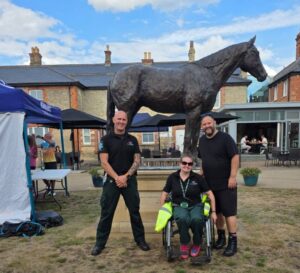
At their worst, Sally says she was experiencing around 100 severe seizures a day.
Nobody could tell her why.
Months later, the seizures remain part of her life and their impact has been enormous.
Sally can no longer walk independently. She uses walking sticks for short distances, with her balance severely affected, and increasingly relies on a wheelchair. She needs support from her partner with both personal care and everyday life and, as a result of her illness, she also lost her job.
There are days when even things most of us take for granted — getting dressed, climbing the stairs or moving around her own home — can become incredibly difficult.
She experiences episodes where she loses the use of her legs for hours at a time and has also experienced episodes affecting her whole body, including her arms and her ability to speak.
For someone who describes herself as having always been fiercely independent, suddenly having to depend on other people has been one of the hardest adjustments.
“Every day I feel like it steals another part of my independence.”
Doctors are still investigating exactly what is happening. Sally has been told that it may be a neurological disorder affecting the signals within her brain, but at the moment there are still more questions than answers.
It may last months.
It may be something she lives with permanently.
Nobody yet knows.
And Sally says that uncertainty is one of the hardest parts.
Finding Somewhere to Belong
Long before the seizures began, Sally had already found something important at Richards Medical.
She first became involved in medical volunteering during a period when her mental health was declining and she had become increasingly isolated at home.
One of our volunteers, Elaine, encouraged her to come along to a duty.
Sally did and she never looked back.
“For the first time in a long time, my brain felt ‘free’ for a few hours.”
Volunteering gave her somewhere to go, people to be around and, most importantly, a purpose.
So when her seizures began changing almost every aspect of her life, Richards Medical became more important than ever.
“My Seizures Have Stolen Too Much”
Losing independence isn't just about whether somebody can walk.
For Sally, it has meant discovering just how inaccessible the world can become when you suddenly need a wheelchair. Places that once required no thought now require planning. Her own home and garden have become harder to navigate and simply going out into the community can feel completely different.
She describes being walked into, tripped over and sometimes feeling almost invisible when using her wheelchair.
“I now feel so lost in society.”
But there is one place where she says that feeling changes. Richards Medical.
Despite everything that had happened, Sally continued to come along to duties when she was able to safely do so, with adaptations and support from the team.
And when the uniform goes on, something changes.
“Once I put my uniform on I feel seen. I feel heard, and the team make me feel like I still ‘fit’ despite my mobility.”
That sentence means an enormous amount to us.
Because inclusion isn't about pretending someone's circumstances haven't changed.
It's about making sure that when they do, the person doesn't suddenly stop mattering.
Sally may need a wheelchair.
She may need things done differently.
There may be things she could previously do that she cannot safely do at the moment.
But she's still Sally.
She's still one of our volunteers.
And she still has something valuable to give.
More Than a Team
Sally describes Richards Medical as her “medic family.”
During an incredibly uncertain period of her life, she says the team have supported her in ways they probably don't even realise.
“There is no judgement. No pressure. We genuinely care about each other. It is a place I feel ‘seen’ where I receive compassion.”
That's the kind of organisation we want Richards Medical Community Trust to be.
Yes, we're here to teach lifesaving skills.
Yes, we're here to provide medical support at events.
Yes, we're here to serve our communities.
But we're also a community ourselves.
Our volunteers aren't numbers on a spreadsheet or simply people available to fill a duty. They're people. Their circumstances change, their health changes and sometimes life throws something at them that nobody could possibly have prepared for.
When that happens, we don't want someone to think that because they can no longer contribute in exactly the same way, they no longer belong.
Sometimes we just need to find a different way.
For Sally, continuing to volunteer gives her something that her illness hasn't been able to take away.
“They shine brightness in my darkness and they make me feel ‘able’. It gives me a purpose to carry on and I can escape the reality of my current personal struggles by giving something back to the community.”
Still Sally. Still One of Us.
We don't know what the next few months will look like for Sally.
Neither does she.
We hope answers come. We hope things improve. And while the medical professionals continue trying to understand what is happening, we'll continue doing something much simpler:
We'll make sure she knows she belongs.
Sally's illness may have changed the way she volunteers.
It hasn't changed the fact that she's one of our volunteers.
And we're incredibly proud that she continues to be part of the Richards Medical family.
Thank you Sally.